
Coal-based charcoal? Coconut shell charcoal? Three methods for on-site identification
The first tip: Examine the appearance and feel - color and texture never lie
This is the fastest and most intuitive method, requiring no tools and can be done on the spot upon receiving the goods.
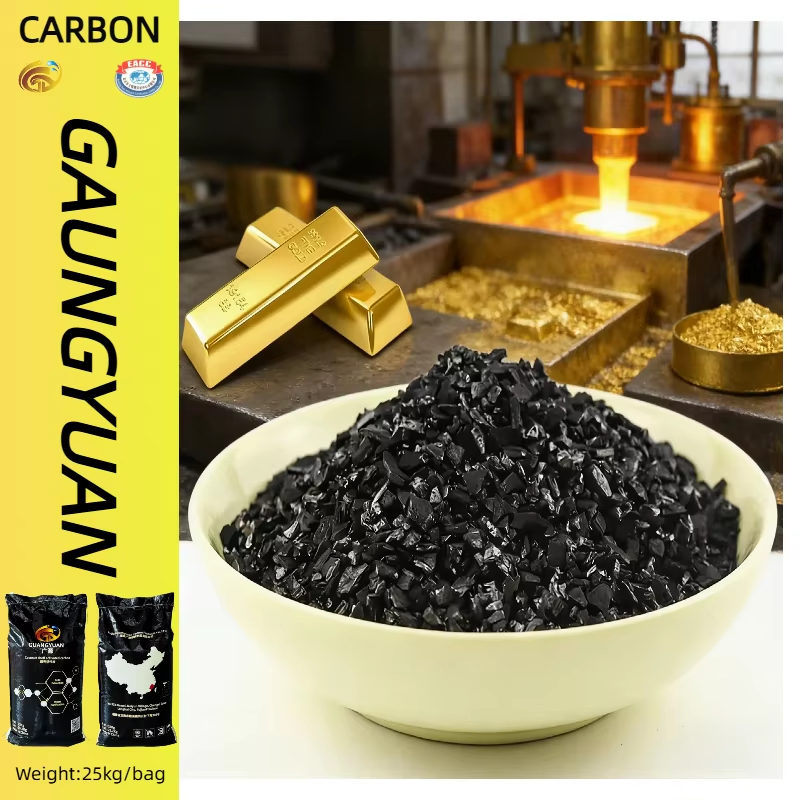
Look at the color: The color of coconut shell charcoal is dark and shiny, with a distinct luster. The surface of the particles has natural undulations, resembling the surface of miniature volcanic rocks. The color of coal-based charcoal is slightly gray-black or dull, with a relatively smooth surface and lacking the natural rough texture. If the entire batch of charcoal looks dull and lacks luster, it is likely to be coal-based charcoal.
Feel the texture: Grasp a handful of charcoal and weigh it. The bulk density of coconut shell charcoal is generally between 0.45-0.55g/cm³, while that of coal-based charcoal is between 0.50-0.65g/cm³. For the same volume of charcoal, coal-based charcoal is significantly heavier. In terms of texture, the particles of coconut shell charcoal are light and airy when held in hand, and there is a distinct porous feel when rubbed by fingers; the particles of coal-based charcoal are denser and harder, feeling like small stones when rubbed.
Observe the shape: The particles of coconut shell charcoal have distinct edges and corners, as the coconut shell itself is in a sheet-like structure. After fragmentation, the edges of the particles are sharp and the shapes are irregular. The particles of coal-based charcoal are more rounded, with fewer edges, and resemble crushed stones. This characteristic is most easily observed in particles with mesh sizes of 8-16 and 12-20.
Method Two: The Floatation Technique - Determine Your True Identity with Just a Cup of Water
This method takes advantage of the density difference between two types of charcoal. The operation is extremely simple: take a transparent glass cup, fill it with about half a cup of room-temperature water, and then take approximately 50 grams of the sample of the charcoal to be tested and slowly pour it into the water.
The particles of coconut shell charcoal have a low density (about 0.9 - 1.1 g/cm³), and a large number of particles will float on the surface of the water. They need to be continuously stirred or left for several minutes before gradually sinking. Even after being fully immersed, there are still a few fine particles floating.
The particles of coal-based charcoal have a high density (about 1.3 - 1.6 g/cm³). When poured into water, they will quickly sink and almost all will fall to the bottom of the cup, with a very low proportion of floating particles. If you see that more than 90% of the particles "puff" downwards, it can basically be determined that it is coal-based charcoal or mixed with coal-based charcoal.
At the same time, pay attention to observing the water surface - when coal-based charcoal is added to the water, it often floats on a layer of fine gray dust, and the water will quickly become turbid; the water body of coconut shell charcoal is relatively clear. This actually reflects the difference in ash content, and it also precisely connects to the third method.
Method 3: Incineration Method - Ash Content - The Most Honest Identity Card
This is the most convincing of the three methods, because the ash content of different types of activated carbon varies greatly, and the chemical activation process cannot change this fundamental characteristic.
Operation method: Take about 20 grams of the activated carbon sample, place it in a stainless steel small dish or crucible, and put it in a muffle furnace or high-temperature furnace. Burn it at 800°C for 2 hours (if there is no muffle furnace, burning it with high heat on a gas stove for 30 minutes can also be used for a rough judgment, but the accuracy will be reduced). After cooling, weigh the weight of the residual ash and calculate the ash percentage.
The ash content of coconut shell charcoal is usually between 3% and 5%, and high-quality products can be as low as below 2%. After burning, the remaining ash is very little and has a light white or light gray color. The ash content of coal-based charcoal is generally between 12% and 20%, and some of the lower-quality ones even reach 25%. After burning, a large amount of ash residue remains, with a color that is slightly gray-brown or rust-colored.
The three steps are not used independently. The most reliable approach is to form a combination of on-site preliminary screening and sample submission for confirmation:
When the goods arrive, conduct the appearance and feel test as well as the floating method within five minutes. This will allow for a preliminary determination of whether there is any suspicion of counterfeiting. If both tests indicate coal-based charcoal, directly refuse the shipment without waiting for the test report. If the appearance and floating method look normal, then perform the combustion method to verify the ash content. If the ash content is normal, it can generally be used with confidence. If the ash content is abnormal, immediately seal the sample and send it to a third-party laboratory for testing simultaneously.
· Fujian Guangyuan Carbon Products Co.,Ltd.